
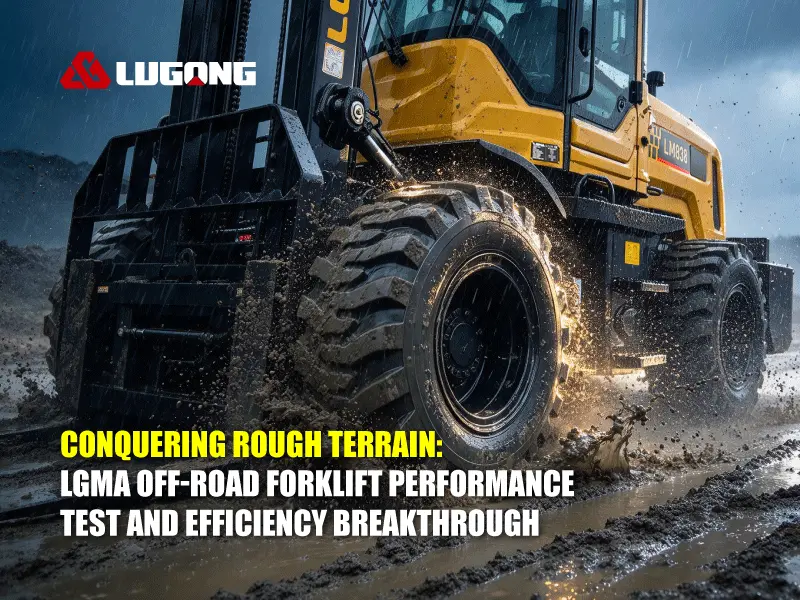
Conquering Rough Terrain: LGMA Off-Road Forklift Performance Test And Efficiency Breakthrough
Material handling poses significant challenges on outdoor construction sites, in remote mining areas, and on complex, soft terrain. LGMA CPY30 off-road forklift ensures high operational availability on challenging terrain through structural optimization of its rear-articulated chassis and precise matching of its powertrain.
Performance Benefits of the Rear-Articulated Chassis
Physical Traction Assurance: Thanks to its heavy-duty rear-articulated frame design, the CPY30 off-road forklift allows the front and rear frames to swing and twist relative to each other in response to terrain changes. This structural design prevents a single drive wheel from becoming airborne due to uneven ground, thereby resolving the problem of wheel spin and slippage on muddy sections.
Maneuverability in Confined Spaces: The rear-articulated CPY30 off-road forklift offers an extremely tight turning radius. Even in narrow aisles piled with materials, forest roadways, or confined construction sites in mining areas, it can still achieve precise positioning and quick U-turns.
Power Output for Heavy-Duty Operations
Power Response: Equipped with a high-performance diesel engine, it delivers a rated power of 55 kW. It delivers outstanding low-speed, high-torque performance, ensuring stable power response when starting on inclines or operating under fully loaded, heavy-duty conditions.
Dual-reduction drive system: Paired with a 265 monoblock torque converter and a 4-speed front/4-speed rear transmission, combined with a small-wheel-end reduction drive axle, this system not only amplifies the torque output at the wheels but also enhances traction on soft terrain.
Technical Specifications for Extreme Terrain
High Maneuverability and Protection: The machine features a minimum ground clearance of 270 mm. This design minimizes the risk of collision between core chassis components and obstacles, ensuring the CPY30 off-road forklift can navigate unpaved surfaces with ease.
Traction Configuration: Equipped as standard with 825-16 off-road semi-solid tires. Their deep tread pattern and wide tread layout provide extremely high ground pressure support, effectively preventing sinking in soft terrain and significantly enhancing operational stability.
Heavy-Duty Rigidity Support: With a curb weight of 4,700 kg, combined with a long wheelbase of 2,285 mm and a track width of 1,428 mm, the machine ensures excellent rollover resistance under a 3-metric-ton rated load.
Frequently Asked Questions
Q1: What are the advantages of the “rear-articulated” design compared to a conventional monocoque frame?
A1: The rear-articulated design of the LGMA CPY30 off-road forklift allows the vehicle body to twist vertically and laterally at certain angles in response to terrain, improving traction on rugged terrain. Traditional monocoque frames are prone to power loss on uneven surfaces when a single side of the vehicle becomes airborne, but LGMA rear-articulated design eliminates this issue.
Q2: How does the CPY30 off-road forklift ground clearance ensure the safety of the drive shaft?
A2: The LGMA off-road forklift exceptionally high ground clearance means the drive shaft and core chassis components operate at a safer height. Combined with off-road tires, this minimizes physical wear on chassis components even when traveling on gravel mine roads.
Summary
From muddy mining sites to rugged construction sites, the CPY30 off-road forklift articulated design enhances the synergy between its technical architecture and real-world operating conditions. With its stable and reliable manufacturing capabilities, LGMA continues to generate economic benefits for global customers in their logistics and material handling operations.


