
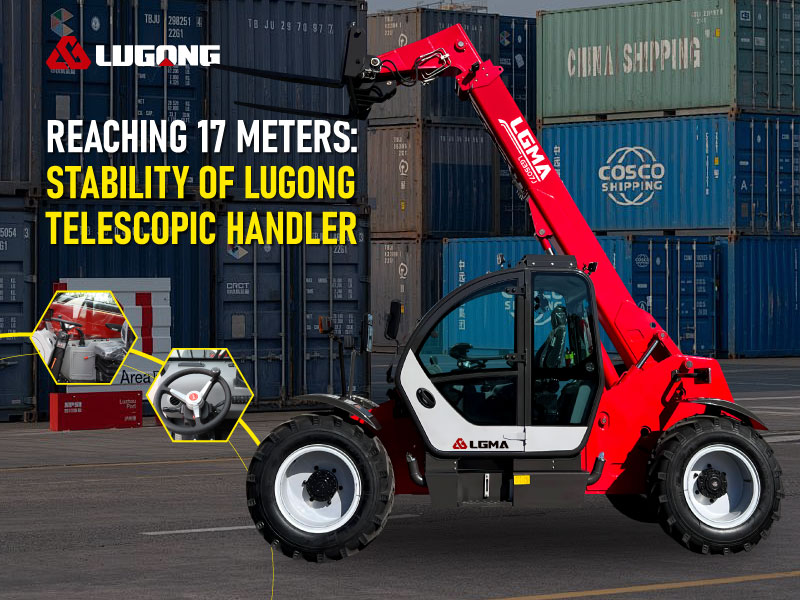
Reaching 17 Meters: Stability of LGMA Telescopic Handler
In modern construction and warehousing and logistics, the vertical lifting height of materials is a key indicator of a machine’s operational capability. LGMA LGTH series Telescopic Handlers includes a variety of models ranging from 7 meters to 17.6 meters, meeting material handling needs at various heights.
Technical Foundation for High-Altitude Models: LGTH1840
Key Operational Parameters: The LGTH1840 telescopic boom forklift has a maximum lifting height of 17.6 meters and a rated load capacity of 4,000 kg. It meets the vertical transport needs for stone, rebar, and other construction materials in multi-story building projects.
Stability Design Logic: To ensure safety during high-altitude operations, the model features a total vehicle weight of 12,600 kg and a long wheelbase of 3.07 meters. When operating on sloped ground, the chassis can be manually leveled to reduce the risk of tipping caused by uneven terrain.
Application Suitability for Mid-Range Models: LGTH1440
Operating Range: The LGTH1440L telescopic boom forklift has a maximum lift height of 13.5 meters and a maximum horizontal reach of 9.5 meters.
Off-Road Capability: The standard 0.43-meter ground clearance and four-wheel-drive system across the entire series ensure the LGTH1440L maneuverability on unpaved terrain. Its four-wheel steering capability reduces the turning radius, making it well-suited for narrow job sites.
Applications for Compact Models: LGTH735
Compact Design and Load Capacity: The LGTH735 telescopic boom forklift has a maximum lift height of 7.0 meters, yet its rated load capacity reaches 3,500 kg. While maintaining a lightweight design, it still offers strong heavy-load handling capabilities.
Maneuverability: With a minimum turning radius of just 3.9 meters, the LGTH735 can turn and position itself in underground garages or narrow aisles, making it a commonly used model in urban renewal projects.
Frequently Asked Questions
Q1: What is the practical benefit of the 0.43-meter ground clearance on the LGTH series telescopic boom forklifts?
A1: Construction sites often feature muddy conditions, deep pits, or loose gravel. Higher ground clearance reduces the likelihood of the undercarriage being scraped by debris, protects the drive shaft and hydraulic lines, and improves the machine’s uptime in challenging terrain.
Q2: How do I select the appropriate steering mode based on the work environment?
A2: Two-wheel steering is recommended for driving in open areas; four-wheel steering is recommended for construction sites with limited turning space; when working close to walls or requiring lateral fine-tuning, the “crab steering” feature—supported by some models—can provide greater flexibility.
Q3: How do you change attachments on a LGMA telescopic boom forklift?
A3: LGMA telescopic boom forklifts are equipped with a quick-change system. In addition to the standard forks, they can be fitted with buckets, log grapples, lifting hooks, or work platforms. This multi-purpose design effectively reduces customers’ overall procurement costs.
Summary
With the LGTH series, LGMA showcases its technical expertise in the telescopic boom forklift sector, offering models ranging from 7 meters to 17.6 meters. From urban infrastructure to modern agriculture, LGMA remains committed to providing construction machinery with appropriate power ratings, reliable quality, and ease of maintenance.


