
Skid-Steer Loaders vs. Wheel Loaders: Which Machine Is Better Suited for Your Work Environment?
In earthmoving, landscaping, and industrial material handling, choosing the right loader is key to controlling operating costs and improving operational efficiency. This article provides an in-depth technical analysis to help you make an informed decision based on your specific work environment.
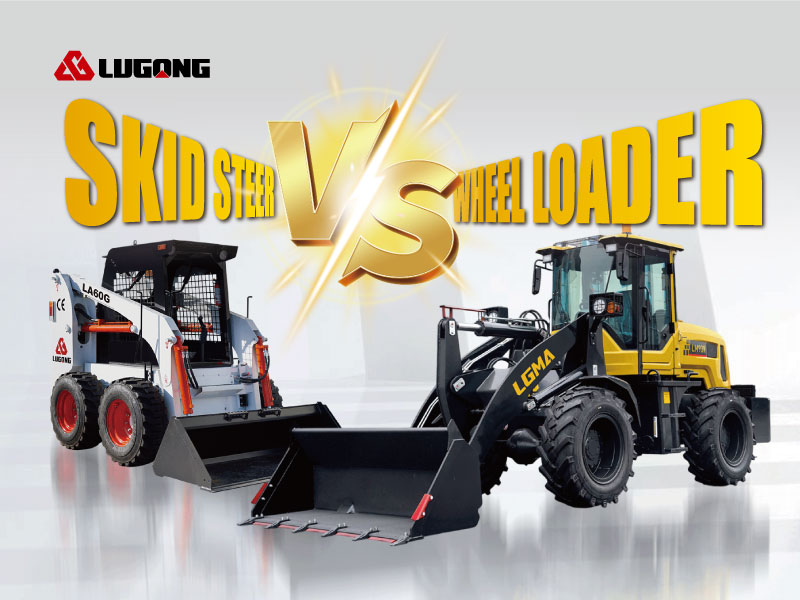
Skid-Steer Loaders:
The defining feature of skid-steer loaders is their “zero-turn radius.” They achieve on-the-spot turning by utilizing speed differentials or reverse rotation between the two sets of wheels.
Suitable Environments: This design gives them unmatched advantages in indoor demolition, basement work, dense farm fencing, or narrow urban alleys.
Wheel Loaders:
Standard wheel loaders typically employ “articulated steering.” When turning, the front and rear frames of the machine pivot around a central pin, with the front wheels following the path.
Suitable Environments: This steering method offers greater stability at high speeds and a smoother turning process. Due to its longer wheelbase, it is better suited for long-distance material transport in open work sites.
Multi-purpose Attachments vs. High-Frequency Loading
Multi-task Scenarios:
A skid-steer loader is essentially a “multi-functional hydraulic platform.” It was originally designed to mount a variety of complex auxiliary attachments.
Technical Logic: With a high-pressure, high-flow auxiliary hydraulic system, it can power enclosed sweepers, milling machines, augers, hydraulic breakers, and more.
High-Load Loading Scenarios:
If more than 90% of your operations consist of simple “bucket work,” a wheel loader is the most efficient choice.
LGMA Machinery’s Technological Differentiation Advantages
Technical Features of LGMA Skid-Steer Loaders:
Reinforced Drive Chain: To handle the high torque generated by skid-steer steering, LGMA employs high-strength drive chains and bearings, significantly extending the maintenance intervals of the transmission system.
Thermal Management System: To address hydraulic oil temperature rise caused by prolonged operation of high-power attachments, the cooling circuit has been optimized to ensure uninterrupted operation even in high-temperature environments.
Technical Features of LGMA Wheel Loaders:
Heavy-Duty Articulated Joint: The steering joint utilizes reinforced pins and tapered roller bearings capable of withstanding massive impact forces generated on rugged terrain.
Fixed-Axle Transmission: Utilizes a market-proven fixed-axle transmission design that delivers smooth power delivery and simple maintenance, performing exceptionally well during frequent forward-reverse operations.
Frequently Asked Questions
Q1: Can a skid-steer loader completely replace a small wheel loader?
A: Functionally, yes, but not in terms of efficiency. The advantages of skid-steer loaders lie in their “maneuverability” and “attachment versatility,” while wheel loaders excel in “loading efficiency” and “ground protection.”
Q2: Why do skid-steer loader tires wear out faster than those on wheel loaders?
A: This is determined by the steering mechanism. Skid-steer loaders steer by dragging their tires across the ground, making this physical friction unavoidable. We recommend selecting tires with different materials and tread patterns based on the working surface.
Summary
LGMA skid-steer loaders address the challenges of confined spaces and complex tasks, while wheel loaders ensure efficiency for high-volume loading and unloading in open areas. Clearly defining your spatial constraints and ground conditions is key to maximizing project benefits.


